Friday, August 31, 2018

Circus Performer and One-Time Actress Frances Belle O'Connor: Gone but Never Lost

On September 8, 1914, former Sheridanite Frances Belle O'Connor was born on her grand matriarch's farm in Renville County, Minnesota. Most people remember her as a circus performer and for her role in the landmark 1932 horror film, Freaks. 

Those who met her or saw her performances noted O'Connor's grace and poise--and astonishing dexterity.

Born without arms, O'Connor taught herself to eat, drink, write, and sew entirely with her feet. With her mother as her manager, she signed on with the bigtime big top at age 15 with the Ringling Brothers while living in Sheridan:


From the March 27, 1930 edition of the
Sheridan Post-Enterprise. Click to enlarge.

While the Ringling Brothers was probably the largest circus O'Connor joined, she found her start in the limelight right here in Wyoming, first with the Al G. Barnes Circus, and later finding work for the Sells-Floto and Cole Brothers Circuses, where she was often billed as "The Living Venus de Milo."


Click to enlarge.
O'Connor's act consisted of her doing mostly things spectators took for granted, such as quaffing a glass of wine or beer, having a steak, or crafting a letter. If you were lucky, you might catch the act in which she braced and aimed a rifle with her feet, pulling the trigger with her toes. And, of course, she'd light up a cigarette and give it a puff or two.

In 1932, O'Connor went on to play Frances, "The Armless Girl,"  in Tod Browning's notorious classic, Freaks (trailer). 


From the February 28, 1932 edition of the Sheridan Press.
Click to enlarge.

While she didn't land a starring role in the ensemble film, she stands out among the company with her trademark grace and poise, which you can see in the clip found here.

Image from Read, Seen, Heard. Click to enlarge.

O'Connor returned to Sheridan for an indeterminate time after Freaks, living on Sheridan Avenue*. From there, she resumed her circus and sideshow career**, supporting both herself and her beloved mother.

By the few accounts left to us, Frances O'Connor had a pleasant demeanor and a sharp sense of humor. As her friend and fellow performer, Jeanie Bernice Tomaini, recalled of their dining excursions, O'Connor evaded yokels' gawking by wearing a cape to conceal her method of eating.

O'Connor was a hit with the gentlemen as well. Author Jeremy Tarcher points out in American Sideshow that O'Connor garnered more than her fair share of marriage proposals because her act allowed her "to show a little more leg than was decent at the time." Eat your heart out, Penelope.

Frances Belle O'Connor eventually retired, choosing to not marry, assuming herself too old to do so (or was she simply fed up with the idea of marriage after so many proposals?). She died in Long Beach, California in 1982, aged 67. While her story may exist only in a few scattered fragments, we're grateful for what we can gather of such a talented performer, intrepid personality, and devoted daughter.


From HumanMarvels.com. Click to enlarge.

*According to the Wyoming Room's city directories.

**Calling a sideshow or circus a "career" may sound strange to contemporary ears, but sideshows and circuses, warts and all, were often the only means to an independent life for people with deformities or disabilities in O'Connor's time. Warner Home Video's hour-long documentary on the performer-actors in Freaks highlights this attitude: you didn't feel sorry for yourself, you were grateful for your job, and you didn't think of yourself as "amazing" or "inspiring"--although you probably got sick and tired of the gawking and the slurs darn quickly.


Friday, August 17, 2018

1866: Fierce Ambrose Bierce Maps Wyoming

Folks in Sheridan County, almost to the littlest urchin, know of Ernest Hemingway's various stays in the Big Horns. Yet another author important to both American history and American literature spent time in Johnson, Sheridan, and other Wyoming counties in the summer of 1866.

Ambrose Gwinnett Bierce lives on in the public consciousness from a handful of short stories, such as "Occurrence at Owl Creek Bridge" and"Chickamauga," and the satirical Devil's Dictionary. Few know his other war stories and tales of supernatural horror. Even fewer have read his reams of journalism--spicy editorials, reviews and even a little muckraking (before objectivity overtook journalism as the preferred voice).

Before he was an author, Bierce was a farm boy, a bricklayer, military academy cadet, printer's devil, and volunteer soldier in the Civil War who lived almost four years warfare.

In the summer of 1866, Bierce took part in a military inspection of Forts Reno, Kearny, C.F. Smith, and Benton, accompanying General William B. Hazen's expedition as a civilian cartographer. What follows is not just the account of Bierce's time in the Big Horns but a snapshot of his tumultuous and colorful life.

Bierce's most iconic portrait,  by John Herbert Evelyn Partington.
Bierce was noted for having a skull and cigar box
always on his desk. Click to enlarge.

To introduce Bierce is no easy task. His many dimensions included compassion, dedication to the underdog, idealism, fierce opponent of nonsense, nonconformity, as well as verbal brutality, misanthropy, and cynicism. He was a person so ferociously ahead of his time that his contemporaries struggled to classify him...politely.

With satire as piercing as his gray eyes and fiery as his auburn locks, Bierce ruffled more than his fair share of feathers in his day. In the biography Bitter Bierce, author C. Hartley Grattan describes the writer as "a perfectionist at a time when public morals were low and private morals were nine tenths hypocrisy." Accordingly, 'Bitter Bierce', a.k.a. the 'wickedest man in San Francisco', called things as he saw them, brooked no nonsense, and cared not a whit whom he razed to ashes with his verbal conflagrations--as long as they deserved it. 

One can trace the threads of Ambrose Bierce's nonconformity to his childhood. As childhoods in the mid 1800s went, his was rough but no rougher than many. In addition to losing three of his twelve siblings, his father, Marcus Aurelius Bierce, ruled the family with an iron hand. Marcus, well-read for his time and station, had a decent library, which laid the foundation for a love of learning in his most rebellious son. Such a dedication to improvement would only embolden the lad under his father's lash, as he later reflected, "Disobedience is the silver lining to the cloud of servitude."

Of Ambrose Bierce's family, his abolitionist uncle, Lucius Verus Bierce, had the most influence on the principled and angry young man. (Lucius was a militant abolitionist with connections to John Brown). 

At age 15, Bierce left home, seeing no reason to stay in hicksville with his family of squares, "I was one of those poor devils born to work as a peasant in the fields, but I found no difficulty in getting out." He tried the Kentucky Military institute, but dropped out at age 18, then becoming a printer's devil for an abolitionist newspaper in Warsaw, Indiana, until the outbreak of the Civil War. 

At just 19 years old, Ambrose Bierce answered President Lincoln's call for volunteers within a week of the Battle of Fort Sumter. 

The next four years would shape Bierce's humor and place in the world in ways he probably never fully grasped. The horrors he experienced and witnessed made an indelible mark on his psyche, causing a mix of what would now be called PTSD and a strangely affectionate longing for the glory days.

Early skirmishes finished quick and with relatively few casualties, lulling men on both sides into thinking the war would be over soon. How tragically wrong they were. As the battlefield is wont to do, it pushed soldiers to absolute honesty about their own courage and conviction. The first major Battle in which Bierce fought, the Battle of Rich Mountain, brought out heroics in the young soldier. Amid a barrage of Confederate bullets, Bierce dragged a gravely wounded comrade to safety, winning renown and a promotion to sergeant major.

Bierce later found himself at Shiloh where his platoon was met with a bloody ambush. In Bierce's fashion, he later immortalized the tragedy and carnage vividly in the short story, "The Coup de Grace," telling not just of slaughter but gory details such as pigs feasting on soldiers' corpses and the wounded being burned alive in brush fires.

Bierce at age 21. Photo from the 
Click to enlarge. 

Shiloh wasn't the end of it. After Bierce found himself at the Siege of Corinth aiding in evacuations, as well as several more battles--providing reconnaissance at two, fighting Southern guerrillas, his luck thinned. At the Battle of Kennesaw Mountain, June 27, 1864, three days after his 22nd birthday, a Confederate sharpshooter's bullet struck him behind the left ear. Despite the initial appearance of death, Bierce miraculously survived only to be hauled on a jostling flatbed railcar for two days--almost three thousand minutes of skull-pounding agony--back to Warsaw. Union doctors were unable to remove all of the bullet; it caused Bierce migraines and blackouts the rest of his days.

Bierce's short short story, "The Other Lodgers," perhaps expresses his state of mind after being shot. The story blurs the lines between the living and the dead; biographer Roy Morris Jr. suggests Bierce, like so many near-death survivors, wasn't "convinced of his own survival." Case in point: the story's narrator, also suffering from a shot to the head, relates the story in a hazy fugue.

Beyond getting shot, 1864 proved a rough year for the future satirist. His engagement to Bernice Wright fizzled. Later in the year, Confederate troops captured Bierce after a breakneck chase through a corn field, despite Bierce spending the night in a tree. Luckily, his captors' hearts were just not in it, and he sneaked away in the night, dodging dogs and fences, avoiding Andersonville and a fate worse than death.

The following January, Bierce received the boon of a medical discharge. Having seen near constant combat for the better part of four years, he was ready for a respite. Despite his affectionate longing for what was perhaps the rush of war, those years haunted Bierce. Of the enthusiastic young soldier who entered the war, he later wrote "I am bound to answer that he is dead." 

Along with migraines and blackouts, the spectre of death haunted Bierce. American literary critic Edmund Wilson, who perhaps is missing the point of Bierce's use of death, supposes it was "Ambroce Bierce's only real character." As a man who beheld as much pointless slaughter, Mr. Bierce was justifiably fixated upon and perhaps perplexed by death, which can be seen in stories such as "Occurrence at Owl Creek Bridge" and "Chickamauga."

Amid the aftershock of the "grand holocaust of slaughter," Bierce's wicked sense of humor and orneriness emerged. As the war drew to a close, Bierce and some of his fellow soldiers decided to get even with a particularly annoying lieutenant. Lieutenant Haberton droned on about his exploits with women, arrogantly confident in his proclamations of rakishness. Bierce and his fellows  convinced a young orderly, one whose effeminate features fit the task, to deck himself in full female regalia and stalk the pompous Haberton. Things went according to plan until Haberton began to ply his wares, a Confederate shell exploded in the floor above. This sent the young orderly fleeing from the room, screaming "Jumping Jee-rusalem," and ditching his "girl-gear." Vexed, Haberton sported "the sickliest grin that ever libeled all smiling," reportedly squeaking "You can't fool me!" It was amazing anyone heard the lieutenant's words above the explosive laughter.

After Bierce's medical discharge from the Union army, he went straight to work for the Treasury Department. His job was to track down and confiscate cotton bales, valued at $500 apiece--roughly $7500 in contemporary dollars. The enterprise proved a rough and dangerous one, a cat and mouse game not entirely unlike that of Treasury agents and mobsters in the Prohibition era.

Exacerbating Bierce's peril was his integrity. The war may have killed the young man in Bierce, but the youth's steadfastness remained: Ambrose Bierce proved the rare Treasury agent who could not be bought. Such an attribute pitted him against all and sundry who benefited from the crooked enterprise of selling cotton bales to the highest bidder, as well as war-weary and Union-hostile residents of the postbellum South--and former Confederate soldiers returned from the war who looked on Lee's surrender as an ephemeral formality.

In April of 1865, Bierce relocated to Selma, Alabama, a veritable hellhole of corruption, thievery, and somewhat justified malice toward the North. Prior to Bierce's arrival, a Union cavalry brigade, under the command of Major General James Wilson, burned down most of the town, including military targets, local businesses, some homes, and the shipyard. Adding insult to injury, Wilson's boys rounded up hundreds of horses and mules, shot them dead, and left them to rot in the Alabama sun. 

Suffice to say, Bierce didn't much enjoy his time in Selma, finding as much scorn and hate sent his way as empathy with Selma's residents. Two marshals, found with their throats cut in the street, marked just the beginning of trouble in the area. The constant danger was such that Bierce and his superior, Captain Sherburne Eaton, would say something memorable to each other every night when they parted in case one was killed in the night. 

Thankfully, Bierce's time in postbellum Alabama had a ceiling. He received a letter from General William Hazen, whom he had served as acting topographical officer from 1863-1864, summoning Bierce to join an inspection tour of forts in the Powder River Territory. Bierce jumped at the chance with nary a second thought.

William Babcock Hazen was one of the precious few people Bierce admired and trusted, writing once that Hazen was "the best hated man I know." The general's soldierly directness and outspoken disdain for political BS impressed the younger soldier--disdain, biographer Richard O'Connor suspects, served as the means by which Hazen could be diverted from providing his particular brand of uncensored commentary on Grant's, Sherman's, and Sheridan's postwar political campaigns. To put it bluntly,  there were fears, probably, that Hazen had some dirt on the former-military-men-cum-politicians.

General William B. Hazen (1830-1887)
Photo from the US Army Center for Military History.
Click to enlarge.

Hazen, formally appointed as inspector general of the Department of the Platte, was tasked with providing reports on the state of the Mountain District, which included Forts Reno and Phil Kearny in Wyoming and C.F. Smith and Benton in Montana.

Bierce joined the Hazen expedition as a civilian cartographer, later writing of his position that "I was not a pilgrim, but an engineer attaché to an expedition through Dakota and Montana, to inspect some new military posts. My duty, as I was given to understand it, was to amuse the general and other large game, make myself as comfortable as possible without too much discomfort to others, and when in an unknown country survey and map our route for the benefit of those who might come after." A cook and teamster, as well as occasional cavalry escorts and guides, rounded out the merry band. Hazen, Bierce, and company set out from Omaha in July of 1866.

The first of many grand sights Bierce beheld--to also include Crazy Woman Flats, Clear Fork, the Black Hills and the Tongue, Platte, Little Bighorn, and Yellowstone Rivers-- was Nebraska's Courthouse Rock, a popular landmark for westward settlers. 

The unfolding journey made Bierce both apprehensive and, perhaps for the first time since the war, animated. One of the few highlights of Bierce's youth was reading about the adventures of Captain Mayne Reid, who explored "Indian Country." Of Courthouse Rock, Bierce, years later, fondly recalled the "crimson glories of the setting sun fringing its outlines, illuminating its western walls like the glow of Mammon's fires for the witches' revel in the Hartz, and flunk like banners from its crest." Longing for the pure, powerful wonder he felt when looking upon the landmark, Bierce added "I wish that anything in the heavens, on the earth, or in the waters under the earth would give me such an emotion as I experienced in the shadow of that 'great rock in a weary land.'" The western frontier impressed Bierce as a land of vast expanses, freedom incarnate. As that frontier shrank under the encroachment of westward expansion, Bierce grew ever more resentful of his fellow Americans.

In the first leg, Hazen's expedition met with little trouble as it turned north onto the Old Bozeman trail. The party did bear witness to macabre signposts, however: makeshift grave markers and bone piles, "not always those of animals," pointed the way. 

Arriving at Fort Reno on August 10, Bierce, Hazen, and company narrowly missed a string of Sioux attacks in the following days. Regardless, Hazen sallied forth with his meager band heading 67 miles northwest to Fort Phil Kearny.

Fort Phil Kearny today, a tiny fragment of the structure that stood before
Ambrose Bierce in 1866. The military abandoned the fort in 1868, turning
it over to the Cheynne, who burned down all but a corner of the wall.
Photo property of the Wyoming Room. Click to enlarge.

The Hazen expedition arrived at Fort Phil Kearny on August 27th and were "hospitably entertained" by the C.O. and other officers. Bierce missed meeting Captain William Fetterman, who fought in many of the same Civil War battles as the future author. In just a few months, Fetterman and others would meet their demise when the Lakota chief, Red Cloud, drew out the fort's soldiers into a massacre.

(Bierce wrote a disorienting tale set in the fort called "A Man with Two Lives.")

Setting out from Fort Kearny, the expedition was accompanied by a cavalry detail led by legendary mountain man and adopted Crow chief, 77-year-old Jim Beckwourth. Beckwourth served as a scout for the fort at that time.

James Pierson Beckworurth (1798-1866).
Photo from the Colorado Virtual Library.
Click to enlarge.

Deep in native country, Bierce felt constantly on edge, fearing an attack at any moment. He vividly describes the atmosphere of night on the open prairie: "...turn your back to the fire and walk a little way and you shall see the serrated summitline [sic] of snow-capped mountains, ghastly cold in the moonlight. They are in all directions; everywhere, they efface the great gold stars near the horizon, leaving the little green ones of the mid-heaven trembling viciously, as bleak as steel." In the passage above, perhaps we're seeing what could be described as the stirrings of cosmic dread, an aesthetic common to works of Weird fiction that Bierce's supernatural horror stories influenced. Appropriately, Bierce punctuates his description of that feeling of  helplessness in the face of a bleak, apathetic nature by recounting the eerie echoes of wolves howling and subsequent, nervous glances toward weapons and horses.

At that moment, General Hazen turned to Beckwourth and asked, "What would you do, Jim, if we were surrounded by Indians?" The seasoned mountain man replied, "I'd spit on that fire."

Hazen, Bierce and company arrived at Fort C.F. Smith safely, perhaps awed they made it all that way with their lives. However, there was another danger lying in wait at the fort.

As a teamster lay "dreaming of home with his long fair hair commingled with the toothsome grass," a grazing bison "half-scalped" the man, lifting him in the air by his fair locks. The teamster hollered a few choice words that "were neither wise nor sweet, but they made such a profound impression on the herd, which, arching its multitude of tails, absented itself to pastures new like an army with banners." Thankfully, this was the last hairy situation the expedition encountered.

The expedition set out from Fort C.F. Smith on its way to Fort Benton. On the way, the men swam the Yellowstone and beheld herds of elk and other wildlife more bountiful and varied than their wildest imaginings. Heading in to Benton as a "sorry-looking lot," the expedition got word it was to return to Washington via Utah, Nevada, California, and Panama--what Bierce derided as "a masterstroke of military humour." When Hazen and company passed through California, they camped on the very spot of the Donner Party's fated winter. Bierce, true to his ghoulish sensibilities, felt he must make comparisons about the meat sizzling over their campfire.

Indirectly, Bierce's time in the plains and Rocky Mountains turned him toward his career as a journalist and author. When in California, Bierce got some news. Previously, he had applied for a return to the military, expecting a captaincy. However, to his and Hazen's cantankerous astonishment, the rank offered was a mere second lieutenant. The incensed Bierce wrote back, declining the offer. Later reflecting upon this turning point in his life, Bierce supposed all turned out for the best: had he become a captain in the military, he suspected he would've eventually been killed or become a dotard.

In Sacramento, Bierce worked as a guard during the day and would pore over books from the library at night, giving himself the education he needed and desired. He would go on to write for William Randolph Hearst's newspaper, composing reams of reviews, opinion pieces, and diatribes; fail at both poetry and gold mining in the Black Hills, divorce after seeing two of his three children die before their mid-twenties, wage a personal war against the railroad, champion underdogs wherever he found them, and finally, meet a mysterious end God knows where and when--among many other mis/adventures.

Of the vibrant life and work of one of America's least appreciated and influential authors, it is a small handful of his prolific output that survives in the American mind today.

Yet without the various sources of wonder and horror in his life, we wouldn't have hidden gems like his treasure trove of biting wit and stories so far ahead of their time in their technique and delivery (not to mention their often disorienting or graphic content). 

Of Bierce's wit, much of his journalism exists in the 12 (yes, count'em, 12!) volumes of his Collected Works and more famously, his Devil's Dictionary, a collection of reworded definitions aimed at the hypocrisies of America's Gilded Age. Every reader is almost guaranteed to find something to delight and offend in equal measure. Try these on for size:

Conservative, n., A statesman who is enamored of existing evils, as distinguished from the Liberal, who wishes to replace them with others.

Apologize, v.t., To lay the foundation for future offence.

Love n., A temporary insanity, curable by marriage.

And hundreds more, absolutely. 

Bierce's pen was a deadly--and often persuasive--weapon.
Picture from Edward M. Erdelac's blog. Click to enlarge.

Beyond Bierce's reams of scathing satire and skewering diatribes, his stories influenced American literature, history, and even 20th-21st Century pop culture. His stories have found their way into the original Twilight Zone, Alfred Hitchcock Presents, and recently, HBO's Masters of Horror ("The Damned Thing"). A handful of short films have also been based on Bierce's stories.

Considering the tall tales, war stories, and supernatural horror and Weird fiction he produced, Ambrose Gwinnett Beirce's own tale came to a probably tragic and fittingly enigmatic end. In 1913, at age 71, he left for Mexico. His exact motives, as stated in letters, were vague. Some speculated he wanted to cover Pancho Villa's revolution; others claimed he wanted to fight in it, desiring death on the battlefield--on his own terms. Still others speculate that Mr. Bierce is still with us, having discovered the fabled Fountain of Youth. The Paris Review presents an interesting variety of theories on the author's fate, with tongue firmly planted in cheek, of course.

The mystery of Ambrose Bierce even made its way onto the silver screen. The 1989 film, Old Gringo, based on Carlos Fuentes' novel of the same name, featured Gregory Peck as Bierce, providing dramatic speculation on the author's fate.

Bierce in his later years. Picture from Time. 
Click to enlarge.

Bierce's final correspondence took the form of a letter to his niece dated December 26, 1913. He appeared to have regained his former vigor, writing "Civilization be dinged! -- It is the mountains and desert for me." His fate remains one of the enduring mysteries in American history. Perhaps 'the wickedest man in San Francisco' proved too much for this weary old world. One could easily imagine him living well past 100 purely out of spite.

The Sheridan County Fulmer Library has the following books by or about Ambrose Bierce:

Ambrose Bierce: Alone in Bad Company, by Roy Morris Jr.

Ambrose Bierce's Civil War by William McCann

The Devil's Dictionary

The Sardonic Humour of Ambrose Bierce, edited by George Barkin


Monday, August 6, 2018

The Sheridan Zoo's Beginnings


Many Sheridanites long for those halcyon days when Kendrick Park (a.k.a. Pioneer Park) hosted Wyoming's largest zoo.

The zoo began operations around 1909 after John B. Kendrick donated the land to the city four years earlier, making a home for mostly critters native to Wyoming. According to various newspaper articles, the zoo was "amateur," which probably meant it was not-for-profit.

Among the first critters housed at the zoo in 1910 were deer, monkeys, goats, and two bears. In March of that year, Kendrick's wife donated an assortment of red squirrels and a pair of golden pheasants.

Photo of the zoo in 1910. Used with the generous permission of Roy Schwartz.

Today, you can see the famous elk and bison inhabiting Kendrick Park. The elk persist thanks to a herd of 25 that spent April, 1910 here en route to the Big Horn Game Preserve from the Jackson Hole area.  The Sheridan Rod and Gun Club spearheaded the endeavor.

The original herd consisted mostly of young elk that were "tame and gentle" and happily oblivious to city officials inspecting them. The 20 that survived were successfully transplanted to the reserve, some distance beyond Eaton's Ranch.

 More happy news greeted June, as the Daily Enterprise reported the hatching of several pheasants and Indian runner ducks.

From the June 2nd, 1910 edition of
the Daily Enterprise. Click to enlarge.

Later that summer, the zoo added a pair of bears, monkeys, and Belgian hares. The monkeys, Abe and Laura, and bears, Nora (black) and Susie (brown), were star attractions. Later that year, the zoo grew by leaps and bounds, adding Columbia river black-tail deer, Bantam Buff Cochin chickens, a dog, and two thousand bass for the pond.

The Pioneer Park pond and fountain in 1930. From the Byron Photo collection.

Through the first years of its life, the zoo continued to grow. In 1914, it added four young bison to the collection, a gift from Kendrick, a collection that also included wolves, coyotes, deer, bears, badgers, porcupines, monkeys, pheasants, a pair of great horned owls, and an assortment of smaller beasts, including rabbits, white rats, and guinea pigs.

Sheridan's Kendrick Park Zoo remained a staple of local activity for decades, including the arrival of Major Sheridan (he will get his own blog post one day). According to a Sheridan Press interview with Tony Pelesky, Sheridan's former public works director, the city dissolved the zoo in 1971. Many Sheridan folks lament its passing, looking back on fond memories of  visits to the park and its critterly residents.


Thursday, July 12, 2018

1980-1987: Sheridan's Renaissance Pleasure Faires

We are delighted to present a little history of the more recent variety...

With the Annual Tournament of Knights coming up this Saturday afternoon, Sheridan Renaissance Faires of yore come to mind.

38 years ago, in "an attempt to bring all facets of the community together in a festive atmosphere reminiscent of Renaissance England," Sheridan held its first Renaissance Pleasure Faire. The Fulmer Public Library* spearheaded the event with other organizations from Sheridan.

Everyone in the community was encouraged to participate by submitting an application, and though "strict authenticity [was] not required regarding goods sold or activities presented," you were required to dress the part.

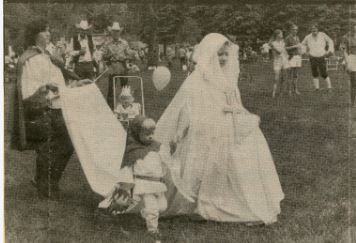
Actors providing "ancestral entertainment" behind painted masks.
From the September 8, 1980 edition of the Sheridan Press.
Click to enlarge.

1500 to 2,000 people strolled through Kendrick Park that late summer afternoon, greeted by a "courtly young gentleman [who] flourished his cape as be bowed his welcome." Attendees enjoyed the mellow atmosphere vividly colored by food and merchandise booths put on by Sheridan businesses, music and theatre performances by local folks, face painting, a petting zoo, tarot cards and fortune tellers (probably lightly so), and jousting and rope pulling contests. Folks could partake of the 1980s version of microbrews as well; "Lancelot's Ale" was a hit.

And stocks as well, if you wanted your picture taken.

Of locals' performances, the most detailed record we have involves a local troupe of storytellers who read Renaissance poetry for fairegoers:

From the September 5, 1980 edition of the Sheridan Press.
Click to enlarge.

The following year proved the first's success, becoming "increasingly popular."


From the September 4, 1981 edition of
the Sheridan Press. Click to enlarge.

From the September 4, 1981 edition of
the Sheridan Press. Click to enlarge.


And 1982 brought even more colorful folks out to the Faire; it expanded to include that year's Wyoming Shakespeare Festival.

The 1982 Renaissance Faire "Mappe."
Click to enlarge.

1982's Renaissance Faire King and Queen.
From the August 27, 1982 edition of the Sheridan Press.

.
From the August 27, 1982 edition of the Sheridan Press.
Click to enlarge.


From the August 29, 1983 edition of the Sheridan Press.
Click to enlarge.

.
1983 has an entire "Royal Family," King Tom, Queen Barbara,
and Prince Joey. From the August 26 edition of the
Sheridan Press. Click to enlarge.

Alas, the Renaissance Faire was simply too good to last. Fortunately, you can create new medieval and Renaissance memories at this year's Tournament of Knights and revisit them by stopping by the Wyoming Room to check out our records.


From the September 14, 1987 edition of the Sheridan Press.
Click to enlarge.

*Our library sponsored the Renaissance Faire for at least six years of its life.


Thursday, June 28, 2018

Doff Aber, Sheridan County's Own Legendary Bronc Rider

Amid the frenzy and hoopla of Sheridan's annual rodeo week, legendary world champion rodeo cowboy, William Douthette "Doff" Aber, is a good one to remember.


Picture from Ancestry.com. Click to enlarge.

Despite the fact he didn't clear his 30s, you still might say Doff Aber lived a full life. Born and bred in Sheridan County (his grandfather came out here from Pennsylvania in the 1880s), Aber grew up on the 61 Bar ranch in Wolf Creek, just north of Dayton. He got his start in Sheridan County rodeos in the late 1920s, later proceeding to ride in the world championship at Cheyenne's Frontier Days.


From the July 26, 1927 edition of the Sheridan Journal.
Click to enlarge.

Aber came into the 1927 championship with the "highest average of any rider." In the finals, he drew what was then called a 'spinner,' which meant he would ride his bronc in slippery mud. Man and horse led a fierce dance, crashing into a fence, but Aber held on; the second crash, however, his bronc tossed him into the muck. It wasn't a total loss, though. Despite Aber's loss, the audience vigorously applauded his "beautiful" ride.

Aber went on to Chicago a few weeks later, marking the shift from amateur to professional. In the late 1920s and early 30s, Aber plied his craft, taking his share of spills and enduring tough luck scenarios--while gaining momentum in rodeo circuits around the country.

The summer of 1930 found Aber a fixture in Greeley and northern Colorado, where his success steadily grew; one of those successful competitions happened 88 years ago this very month.

From the July 5, 1930 edition of the
Greeley Daily Tribune. Click to
enlarge.

1930 also marked the year Aber found love, marrying Dorothy Loveland (neè Harries), a "society girl" from Washington whose parents were staying at Eaton's that summer. As he and Dorothy enjoyed their newfound marital bliss, Aber enjoyed a streak of modest wins as he rode in dozens of rodeos a year, but financial security and renown eluded him.

Click to enlarge. Year unknown.

It wasn't until 1935, eight years on the circuit, that Aber began to receive the recognition he deserved.  At a Los Angeles rodeo in August of that year, Aber rode fourteen broncs--nine of which in three days-- sealing his championship with the notorious "Ham What Am." Aber hung on for one more jump than the stiff competition, Earl Those and Pete Knight, winning top honors.


From the July 5, 1937 edition of the
Great Falls Tribune. Click to enlarge.


From the September 24, 1938 edition of  the
Billings Gazette. Click to enlarge.

In 1941 and 1942, the fruits of Aber's labors were realized as he became world champion bronc rider for that pair of years. It was no mere luck, however, that brought him such accolades. Doff Aber became the top bronc rider in the world because of a hard-as-nails work ethic and true grit that would make both Charles Portis and John Wayne blush. In 1941 alone, Sheridan County's home grown bucking bronc champ competed in 38 contests.


From the July 26, 1942 edition of the
Santa Rosa, California Press Democrat. 
Click to enlarge.

Nor was it flashiness that brought this "son of the Northwest" to the zenith of his career. Author Clifford Westermeier, who knew Aber, observed  that this particular cowboy "was never a studied or planned showman of the spectacular; in his simplicity and directness of action he always gave a good show." Aber didn't need to put on a show. He rode purely for the pleasure of it and it showed.

Today, rodeo has become a controversial topic in some circles regarding animals' experience. Make no mistake though, Doff Aber, like many rodeo cowboys of his time and beyond, had a deep-founded respect and admiration for their critters--and, perhaps, kindred spirits.

Cited in Westermeier's Man, Beast, Dust: The Story of Rodeo, Aber explains the strangeness when the "Five Minutes to Midnight" suddenly quit bucking one night, with many fearing the legend's days were numbered: "'Old Five Minutes to Midnight' is one of the smartest horses in rodeo. He will bring a man out of the chute with a fast choppy movement and if he doesn't throw him on the first two or three jumps, 'Five Minutes' will slow down to an easy glide.'" He continued, adding that the horse "will turn his head around, take a look at the rider and just like this--" snapping his fingers three times to show how many bucks the horse would take to dump his rider.


Click to enlarge.

If Aber stood before us right now, explaining old "Five Minutes to Midnight," we would behold a man in his element, eyes flickering with the vigor of a dream realized. He loved talking shop, to put it mildly. Anything--everything-- rodeo.

You'd think the tough times that plagued his start in the sport would plant some sour grapes, but Aber fondly recalled such times-- or any times in the ring, for that matter--crafting "well-paced" stories.

Part of the draw for rodeo cowboys is the thrill of danger, and it probably was for Aber, too. After riding all those bucking broncs and the blood, sweat and tears in his 17 years in the ring, William D. Aber's life met a sudden end. While working on his Wellington, Colorado dairy farm in May of 1946, he died in a freak accident.

Aber had retired from the rodeo eighteen months prior and was no doubt looking forward to settling down with his third wife, Patricia (neè Cowan), and little daughter on a dairy farm he jointly owned and operated with his father, Perry.

According to the Sheridan Press, when Aber and his sister were taking a new tractor for an inaugural run, it ran afoul of an irrigation ditch, rolling over, injuring her and killing him, probably instantly.

As sometimes happens in historical research, we found variations in the story of Aber's death. A Reno Gazette-Journal obituary reported that Aber had died "while working with a piece of army equipment"; according to FindAGrave.com (via the Sheridan County GenWeb project cemetery records), that piece of equipment was a Jeep. And the Herald and News of Klamath Falls, Oregon, claimed the deadly vehicle was a snow tractor?

Regardless of the minutiae of his death, Aber left this world far too soon at just 38, his new life with his new family cruelly cut short. This year, when you're in the stands cheering on cowboys and cowgirls--or just about to enter the ring yourself-- give ole Doff a tip of your hat. I think that just might make his day.


Sunday, June 10, 2018

1928: The First P.K. Ranch Rodeo

"Just a bit of warning," a Sheridan Post-Enterprise writer advised, "if you want to reach the PK in time for the rodeo, start early. There's going to be a crowd." A crowd indeed. 17,000 eager spectators showed up for the first ever PK Ranch rodeo 90 years ago this month. A remarkable feat indeed, since the PK Rodeo happened the same day as the 1928 Cheyenne Frontier Days' finale.

The PK Ranch, homesteaded between 1889 to 1913 by the Patrick family, found its way into the hands of P. J. Morgan of Cleveland, Ohio, in 1925. P.J. bought the land for $200,000, or $3.6 million in 2018 dollars, that May.

While P.J. preferred to stick to the sidelines, his wife, Mary (neé Butts), and son, Jaxon Morgan, managed the ranch for 20 odd years.

P.J. and Mary Morgan. Pictures from Ancestry.com.
Click to enlarge.

On July 28, 1928, the Morgans put on the P.K. Ranch Rodeo, the first such "spectacle in the way of a rodeo that has been seen in many years." And they didn't charge a dime. As PK ranch foreman Harry Fulmer explained, the rodeo was "open to the world." The Morgans wanted to both advertise the region and restore some of that old Wild West vigor to Sheridan.

The 1929 PK Rodeo, from the Byron Photo Collection.
Click to enlarge.

Spectators from 28 states and cowboys, mostly from northern Wyoming and southern Montana, began to assemble at 8:30am in the cool morning weather. The festivities ran until well into the afternoon under partly cloudy skies and a pleasantly balmy high of 85.


Undated. From the Cooksley Collection.
Click to enlarge.
The throng cheered cowboys as they competed in bucking, calf roping, steer roping, bulldogging, wild cow milking, and the climax, a wild horse race. Judging events were Fred Hesse of Buffalo, "Boy" Cobble of Forsyth, MT, and John Wentz of Basin.

From the July 24, 1928 edition of the
Sheridan Post-Enterprise. Click to enlarge.

Prizes included $1000 cash for third, a silver mounted saddle for second, and grand prize was a Hupmobile Roadster, pictured below.

From the July 27, 1928 edition of the
Sheridan Post-Enterprise. Click to enlarge

In addition to setting record attendance--almost twice the population of Sheridan showed up in 3,274 autos--the rodeo went off with just a few close scrapes, with everyone returning home in one piece. As far as winners, Curly Wetzel of Wolf and Burton Brewster of Birney, MT won third and second prize, respectively. Who took home the cherry Hupmobile Roadster? A Wyoming boy, thankfully: Cheyenne's Billy Kingman.


Monday, May 14, 2018

A Few Tidbits about Eaton's Ranch and Its Annual Horse Drive

The annual Eaton's horse drive happens this year on Sunday, May 27th. Eaton's wranglers will move about 100+ horses 100+ miles from their winter pastures to summer pastures for guests' riding pleasure. The horses and cowboys travel through Sheridan, usually via 5th Street, for folks to view. In the fall, the horses make the return trip.

The 1974 horse drive, picture from the June 16, 1974 edition
of the Billings Gazette. Click to enlarge.

Nobody seems to be exactly sure when the drive began, at least according to our records.  In a May 21, 1999 Sheridan Press article, then employee Dick Bacon said the horse drive had been going on for "60 to 75 years," which places the start somewhere between 1925 and 1940. A 1967 Press article dates the drive possibly earlier, to the "early 1900s."

A June 1964 Sheridan Press article called the drive "one of those signs of summer." The aforementioned 1967 piece said the return trip was a sign that "fall is officially here." Even though the drive has become a spectator event only in recent years, it has marked the shifting of the seasons for Sheridanites for quite a few years.

Sheridan artist Stan A. Morgan's depiction of an Eaton's drive
of yore along the Ulm Road. From the November 7th edition
of the Sheridan Press. Click to enlarge.

Picture of the horses coming through Sheridan. From a June, 1965
Western Horseman article. The article was generously shared by
Gail Wright of MCC Magazines and is available in the Wyoming Room.
Click to enlarge.

Those horses you see are the bread and butter of the ranch's operations; their descendants remain the main attraction to this day. Yet the ranch didn't start out as a guest entertainment business.

According to a June 1965 Western Horseman article, the founding brothers, Howard, Willis, and Alden Eaton, started a ranch near Medora, North Dakota, that family and acquaintances from back East frequented. One such guest, a Pittsburgh entrepreneur, thought the brothers should recoup the expenses of so many folks occupying space and eating up vittles, some of whom stayed on for months. The brothers initially balked at the idea, thinking "any charge would be a breach of western hospitality." Soon, however, they simply had too many guests to manage with too few resources and thus formed the world's first ever dude ranch business. They moved operations to the Big Horns in 1904 where the ranch has been ever since.

The Eaton Brothers in 1911. From the Wyoming Room
Photo Collection. Click to enlarge.

Some of the more famous guests included former Secretary of the Interior, Harold Ickles; former Librarian of Congress and renowned poet, Archibald MacLeish; General George C. Marshall; actors Fred MacMurray and Cary Grant, and author Annie Proulx, as well as many others.

Guests take in the grandeur of the Big Horns by getting out and enjoying fishing, hiking, barbecues, swimming, and the perennial favorite, horseback riding. Many folks have even found romance at Eaton's; the ranch holds several weddings a year as well. Over the years, dudes both famous and not so famous alike rode astride Eaton's noble steeds...

From the Cook Photo Collection.
Click to enlarge.


And took in rodeo shows...

From the Cook Photo Collection.
Click to enlarge.


From the Cook Photo Collection.
Click to enlarge.


From the Cook Photo Collection.
Click to enlarge.


And went on trips via horseback to Yellowstone, this one in 1908, during which ranch guests rode trails with the cook outfits and beds following.

From the Dygert Photo Collection.
Click to enlarge.


Eaton's guests may pay for their room and board during their venture in the Big Horns, but the ranch is much more than just a business. It stayed in the family through 14 decades, weathering tough times more than once, the Stock Market Crash of 1929 and the ensuing Great Depression not the least of them. Many folks in these parts feel Eaton's ranch is as much a part of the landscape and culture as the Big Horns themselves.

If you're interested in learning more about the world's first and longest-lasting dude ranch--trust us, this little ole blog post barely clears the tip of the iceberg--come on in to the Wyoming Room at the Sheridan County Library. We have several newspaper articles, a book by Tom Ringley and two by Esther McWilliams, as well as several issues of the ranch's self-published newsletter, Wranglin' Notes.


Thursday, May 10, 2018

The Mysterious Wimpus, Captured from Lake DeSmet, July 1915

Just after the 4th of July in 1915, Sheridan shuddered with excitement at the presentation of a strange creature, the mysterious wimpus.

From the July 6 edition of the Sheridan Post.
Click to enlarge.

An unnamed fisherman, seeking "a good mess of festive carp," pulled the wimpus up from Lake DeSmet's murky depths, "that famed home of sea-serpent and dinosauria." The creature's unwilling chaparone took his ward to town, showing it at the Mint Saloon, where the wimpus soon became the talk of Main Street.


The historic Mint Bar in 1992, mostly unchanged since its early days.
Photo by Anita Nichols. Click to enlarge.

Awed locals were beside themselves. Described as "[having] a bull head and three horns on each side...about as long as a short piece of rope and as big around as two sweet potatoes...in color, it resembles lead, being neither black nor gray," the wimpus stupefied and befuddled. Its horns were "built like a buffalo's horns, a water buffalo's...that is, they turn backward." The wimpus was supposed to be "deadly poisonous" as well.

The article pondered whether such a  beast had been swimming DeSmet's bottomless depths-- a creature that might have been "the last of strange animals which inhabited the swampy reaches of the earth" that fled to DeSmet's waters when "the last dry wave swept the country."

Theories swirled in the Mint Bar; some, grounded, suggested the creature was a variant of different known species while others insisted the beast was a prehistoric remnant, alive and well, in the modern age. One imagines a ruckus of raised voices with the slamming of beer mugs onto bar tables, punctuating colorful "scientific" diatribes.

With the bar atmosphere deemed a touch "incredulous," "Mr. Wimpus" was moved to the Pioneer Park Zoo, where he would live in the company of "gaters [sic] and other varmints" the rest of his days.

Pioneer Park in 1911. From the Gunstrom Collection.
Click to enlarge.

Tongue firmly planted in cheek, the article suggested that, with the right pink ribbon wrapped around its tail, the wimpus might "make an elegant substitute for a lapdog." With the many tall tales of Lake DeSmet's monster--some of which you can read about here--it's clear many in Sheridan had not only a sense of wonderment but humor about the otherworldly creature.

Without further ado, we present to you a picture of one of Mr. Wimpus's modern day relatives--a.k.a. a water dog-- in its resplendent glory:

Photo from Animal-Image.com.
Click to enlarge.