Sunday, June 10, 2018

1928: The First P.K. Ranch Rodeo

"Just a bit of warning," a Sheridan Post-Enterprise writer advised, "if you want to reach the PK in time for the rodeo, start early. There's going to be a crowd." A crowd indeed. 17,000 eager spectators showed up for the first ever PK Ranch rodeo 90 years ago this month. A remarkable feat indeed, since the PK Rodeo happened the same day as the 1928 Cheyenne Frontier Days' finale.

The PK Ranch, homesteaded between 1889 to 1913 by the Patrick family, found its way into the hands of P. J. Morgan of Cleveland, Ohio, in 1925. P.J. bought the land for $200,000, or $3.6 million in 2018 dollars, that May.

While P.J. preferred to stick to the sidelines, his wife, Mary (neé Butts), and son, Jaxon Morgan, managed the ranch for 20 odd years.

P.J. and Mary Morgan. Pictures from Ancestry.com.
Click to enlarge.

On July 28, 1928, the Morgans put on the P.K. Ranch Rodeo, the first such "spectacle in the way of a rodeo that has been seen in many years." And they didn't charge a dime. As PK ranch foreman Harry Fulmer explained, the rodeo was "open to the world." The Morgans wanted to both advertise the region and restore some of that old Wild West vigor to Sheridan.

The 1929 PK Rodeo, from the Byron Photo Collection.
Click to enlarge.

Spectators from 28 states and cowboys, mostly from northern Wyoming and southern Montana, began to assemble at 8:30am in the cool morning weather. The festivities ran until well into the afternoon under partly cloudy skies and a pleasantly balmy high of 85.


Undated. From the Cooksley Collection.
Click to enlarge.
The throng cheered cowboys as they competed in bucking, calf roping, steer roping, bulldogging, wild cow milking, and the climax, a wild horse race. Judging events were Fred Hesse of Buffalo, "Boy" Cobble of Forsyth, MT, and John Wentz of Basin.

From the July 24, 1928 edition of the
Sheridan Post-Enterprise. Click to enlarge.

Prizes included $1000 cash for third, a silver mounted saddle for second, and grand prize was a Hupmobile Roadster, pictured below.

From the July 27, 1928 edition of the
Sheridan Post-Enterprise. Click to enlarge

In addition to setting record attendance--almost twice the population of Sheridan showed up in 3,274 autos--the rodeo went off with just a few close scrapes, with everyone returning home in one piece. As far as winners, Curly Wetzel of Wolf and Burton Brewster of Birney, MT won third and second prize, respectively. Who took home the cherry Hupmobile Roadster? A Wyoming boy, thankfully: Cheyenne's Billy Kingman.


Monday, May 14, 2018

A Few Tidbits about Eaton's Ranch and Its Annual Horse Drive

The annual Eaton's horse drive happens this year on Sunday, May 27th. Eaton's wranglers will move about 100+ horses 100+ miles from their winter pastures to summer pastures for guests' riding pleasure. The horses and cowboys travel through Sheridan, usually via 5th Street, for folks to view. In the fall, the horses make the return trip.

The 1974 horse drive, picture from the June 16, 1974 edition
of the Billings Gazette. Click to enlarge.

Nobody seems to be exactly sure when the drive began, at least according to our records.  In a May 21, 1999 Sheridan Press article, then employee Dick Bacon said the horse drive had been going on for "60 to 75 years," which places the start somewhere between 1925 and 1940. A 1967 Press article dates the drive possibly earlier, to the "early 1900s."

A June 1964 Sheridan Press article called the drive "one of those signs of summer." The aforementioned 1967 piece said the return trip was a sign that "fall is officially here." Even though the drive has become a spectator event only in recent years, it has marked the shifting of the seasons for Sheridanites for quite a few years.

Sheridan artist Stan A. Morgan's depiction of an Eaton's drive
of yore along the Ulm Road. From the November 7th edition
of the Sheridan Press. Click to enlarge.

Picture of the horses coming through Sheridan. From a June, 1965
Western Horseman article. The article was generously shared by
Gail Wright of MCC Magazines and is available in the Wyoming Room.
Click to enlarge.

Those horses you see are the bread and butter of the ranch's operations; their descendants remain the main attraction to this day. Yet the ranch didn't start out as a guest entertainment business.

According to a June 1965 Western Horseman article, the founding brothers, Howard, Willis, and Alden Eaton, started a ranch near Medora, North Dakota, that family and acquaintances from back East frequented. One such guest, a Pittsburgh entrepreneur, thought the brothers should recoup the expenses of so many folks occupying space and eating up vittles, some of whom stayed on for months. The brothers initially balked at the idea, thinking "any charge would be a breach of western hospitality." Soon, however, they simply had too many guests to manage with too few resources and thus formed the world's first ever dude ranch business. They moved operations to the Big Horns in 1904 where the ranch has been ever since.

The Eaton Brothers in 1911. From the Wyoming Room
Photo Collection. Click to enlarge.

Some of the more famous guests included former Secretary of the Interior, Harold Ickles; former Librarian of Congress and renowned poet, Archibald MacLeish; General George C. Marshall; actors Fred MacMurray and Cary Grant, and author Annie Proulx, as well as many others.

Guests take in the grandeur of the Big Horns by getting out and enjoying fishing, hiking, barbecues, swimming, and the perennial favorite, horseback riding. Many folks have even found romance at Eaton's; the ranch holds several weddings a year as well. Over the years, dudes both famous and not so famous alike rode astride Eaton's noble steeds...

From the Cook Photo Collection.
Click to enlarge.


And took in rodeo shows...

From the Cook Photo Collection.
Click to enlarge.


From the Cook Photo Collection.
Click to enlarge.


From the Cook Photo Collection.
Click to enlarge.


And went on trips via horseback to Yellowstone, this one in 1908, during which ranch guests rode trails with the cook outfits and beds following.

From the Dygert Photo Collection.
Click to enlarge.


Eaton's guests may pay for their room and board during their venture in the Big Horns, but the ranch is much more than just a business. It stayed in the family through 14 decades, weathering tough times more than once, the Stock Market Crash of 1929 and the ensuing Great Depression not the least of them. Many folks in these parts feel Eaton's ranch is as much a part of the landscape and culture as the Big Horns themselves.

If you're interested in learning more about the world's first and longest-lasting dude ranch--trust us, this little ole blog post barely clears the tip of the iceberg--come on in to the Wyoming Room at the Sheridan County Library. We have several newspaper articles, a book by Tom Ringley and two by Esther McWilliams, as well as several issues of the ranch's self-published newsletter, Wranglin' Notes.


Thursday, May 10, 2018

The Mysterious Wimpus, Captured from Lake DeSmet, July 1915

Just after the 4th of July in 1915, Sheridan shuddered with excitement at the presentation of a strange creature, the mysterious wimpus.

From the July 6 edition of the Sheridan Post.
Click to enlarge.

An unnamed fisherman, seeking "a good mess of festive carp," pulled the wimpus up from Lake DeSmet's murky depths, "that famed home of sea-serpent and dinosauria." The creature's unwilling chaparone took his ward to town, showing it at the Mint Saloon, where the wimpus soon became the talk of Main Street.


The historic Mint Bar in 1992, mostly unchanged since its early days.
Photo by Anita Nichols. Click to enlarge.

Awed locals were beside themselves. Described as "[having] a bull head and three horns on each side...about as long as a short piece of rope and as big around as two sweet potatoes...in color, it resembles lead, being neither black nor gray," the wimpus stupefied and befuddled. Its horns were "built like a buffalo's horns, a water buffalo's...that is, they turn backward." The wimpus was supposed to be "deadly poisonous" as well.

The article pondered whether such a  beast had been swimming DeSmet's bottomless depths-- a creature that might have been "the last of strange animals which inhabited the swampy reaches of the earth" that fled to DeSmet's waters when "the last dry wave swept the country."

Theories swirled in the Mint Bar; some, grounded, suggested the creature was a variant of different known species while others insisted the beast was a prehistoric remnant, alive and well, in the modern age. One imagines a ruckus of raised voices with the slamming of beer mugs onto bar tables, punctuating colorful "scientific" diatribes.

With the bar atmosphere deemed a touch "incredulous," "Mr. Wimpus" was moved to the Pioneer Park Zoo, where he would live in the company of "gaters [sic] and other varmints" the rest of his days.

Pioneer Park in 1911. From the Gunstrom Collection.
Click to enlarge.

Tongue firmly planted in cheek, the article suggested that, with the right pink ribbon wrapped around its tail, the wimpus might "make an elegant substitute for a lapdog." With the many tall tales of Lake DeSmet's monster--some of which you can read about here--it's clear many in Sheridan had not only a sense of wonderment but humor about the otherworldly creature.

Without further ado, we present to you a picture of one of Mr. Wimpus's modern day relatives--a.k.a. a water dog-- in its resplendent glory:

Photo from Animal-Image.com.
Click to enlarge.


Wednesday, April 11, 2018

April 1929: Sheridan's First 'Talkies' Draw Throngs


Sheridan movie buffs rejoice!

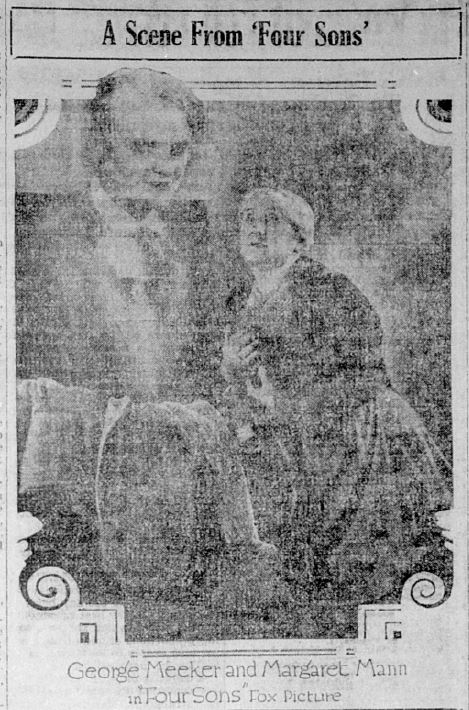
Silent movies were all the rage for Sheridanites in the teens and twenties of the last century, but the trend was soon to change. On April 18th, 1929, the first sound movie shown in Sheridan, legendary director John Ford's new film, Four Sonsopened at the Lotus Theater (now the Wyo Theater).

Four Sons poster from the April 16, 1929 edition
of  the Sheridan Journal.
Click to enlarge.

(Fun fact: Four Sons featured a young John Wayne playing an officer.)

The new sound movies were known colloquially as 'talkies'. Four Sons wasn't a talkie, strictly speaking, but it did feature a music and effects track. The true talkie of the night, the 15-minute short film, The Carnival Man, opened with Four Sons, as well as the newsreel, "Fox Talking News," and a "grand opera selection," accompanied by a Fox 100-piece orchestra.

Movie snapshot from the April 21 edition
of the Sheridan Post-Enterprise.
Click to enlarge.

People flocked to the Lotus, with the first showing jam packed and folks waiting hours to see the second. Amid  the fanfare and hoopla, it was the little Carnival Man, an "all-talkie dramatization of carnival life," that stole the show.


Scene from The Carnival Man. Image from IMDB.com.
Click to enlarge.

The Sheridan Post-Enterprise joined in the revelry, celebrating the spankin' new cinematic experience: "No more will Sheridan Cinema patrons have to contend with the trap-drummer's imitation of machine gunfire, horses [sic] hoofs several seconds too late, explosion of sound after the real explosion has settled, for Sheridan now boasts a complete equipment for movietone productions." Think going from mono to Dolby 7.0 Surround Sound.

Add expert testimony to boot. Engineer Fred Cole of the DeForest laboratory, who set up the Lotus for sound pictures, lauded the building, saying it was "the best theater for acoustics he has ever equipped." The Wyo Theater's acoustics are renowned to this day.

The big doin's extended beyond state-of-the-art explosions of sound. The Lotus upgraded to the then equivalent of widescreen, which "permit[ted] viewing the pictures from the side-wings of the stage with but little distortion" a softer, less grainy picture on a screen conducive to a "free flow of sound."

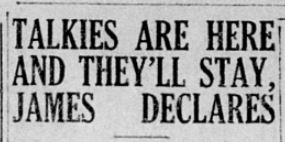
The then manager and co-owner of the Lotus, Fred Bezold, and  co-owner James Young (who managed the Orpheum) enthusiastically praised the forthcoming event, making sure to encourage folks from Sheridan and surrounding areas to prop the monumental expense of installing new equipment:

From the April 16, 1929 edition of  the Sheridan Journal.
Click to enlarge.
So. What did Sheridanites say about the experience? Apparently, there was some resistance to talkies, Bezold felt "elated at the compliments received on the show." Looks like the newfangled moviegoing experience met with Sheridanites' approval.

(Apparently, this Arthur James person was dead on.)


Saturday, April 7, 2018

Edward S. Curtis Photos Now On Display

We are proud to host part of the Edward S. Curtis collection of photos, 19 of which are on display right here in the Wyoming Room until May 23.

Just some of the photos we've been fortunate enough to bring to you.
Click to enlarge.

Edward Sheriff Curtis (1868-1952), a.k.a. 'Shadow Catcher,' was an ethnologist and photographer of renown, preserving photographic history of Native American cultures in the early 20th Century.

Curtis's self portrait, taken from PBS.org.
Click to enlarge.

Growing up in Wisconsin and Minnesota, Curtis spent his time learning the photography trade, fostering a growing love and appreciation for the great outdoors. The turning point in his career came when famed naturalist and anthropologist, George Bird Grinnell, invited Curtis to Montana to see the the then dying ritual of the Plains Indians' Sun Dance in 1900.

From then until 1930, Curtis traveled the continent, making some 40,00 photographs (as well as upwards of 10,000 sound recordings) of people from more than 80 tribes from the Inuit of the north to the Navajo of the southwest.

A health crisis, one from which he never fully recovered, forced Curtis into retirement in 1930. He took things relatively easy, writing and doing photography here and there, even shooting the 1936 Gary Cooper western, The Plainsmen, for director Cecil B. DeMille. 

Photo of a young Arikara woman.
Click to enlarge.


Photo of Tearing Lodge, of the Piegan band, the largest
of the three that composed the Blackfoot people.
Click to enlarge.

Curtis's health continued a slow decline until his death in 1952 at the age of 84. The legacy of his subjects endures, though, vivifying the grace, beauty, and power of these more than eighty Native American cultures, without which far too much would have been lost to history.

We also have seven books by or about Curtis for your enjoyment, containing 
hundreds more of his pictures.

Click to enlarge.


Tuesday, March 27, 2018

Sheridan's 1918 Easter


Easter weekend in Sheridan 100 years ago was a balmy affair, with Good Friday topping 61 and the following day a beautiful 72;  Easter Sunday dipped a bit but was still a sunny 61.

Basking in that unseasonably warm weather, the town bristled with church activities. The Holy Name and Congressional churches held special music programs. The Methodist Episcopal church held a 7am communion, followed by a "love feast." The Presbyterians hosted the DeMolay commandry of the Knights Templary which "exempl[ified] the work of masonry." Mrs. Jones, "the Welsh singer" oversaw the First Baptist church's Easter program.

Before the music and feasts and services, Sheridanites had the honor--or whatever you want to call it--of being among the first Americans to set their clocks back for Daylight Saving time the previous night. We imagine there were plenty of yawns and red eyes in church that Easter morning.

From The Sheridan Daily Enterprise, March 31, 1918.
Click to enlarge.

The Monday celebrations the article above mentions included several dances as well as the Episcopal Guild's annual Easter Monday Bazaar.  

Leading up to the holiday, local businesses maximized efforts to capitalize on the Easter momentum in the public mind, touting Easter dresses, shoes, and suits. Or a plant or two. (Not much has changed, in that regard, in the years since.)

Click to enlarge.
Click to enlarge.


Sunday, March 25, 2018

Historical Photos of Churches

With Easter approaching, here are a few church photos from some of our collections.

Log cabin church in the Bighorn Mountains, year unknown.
From the Elsa Spear Byron collection.
Click to enlarge.

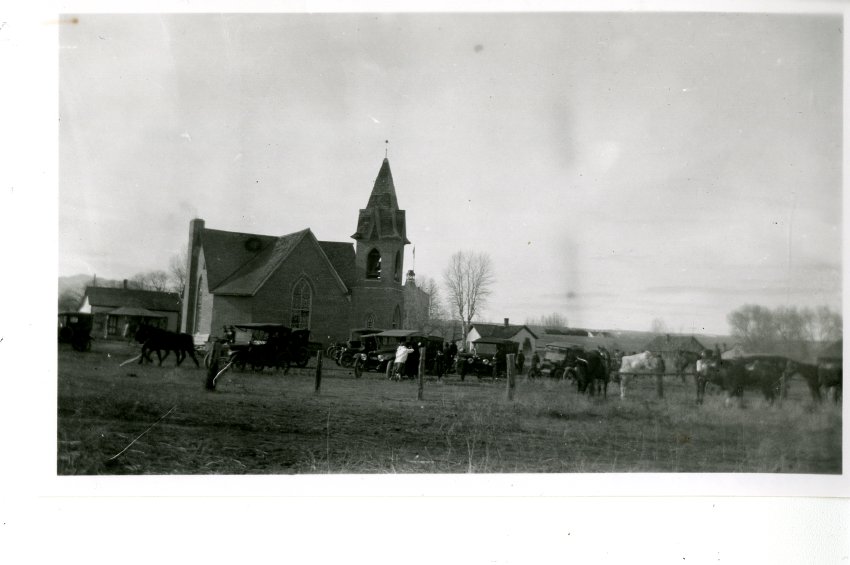
This is how Sheridanites used to roll on Sunday mornings.
From the Cooksley collection.
Click to enlarge.

First Baptist Church in 1895, with many pioneer families
present: Colliers, Houghtons, Goodnights, Calloways, Simeses,
Evanses, Weltners, and Guyers (the photo was annotated
"Property of E.G. Guyer").
From the Bourne collection.
Click to enlarge.


First Baptist Church in 1920.
From the Bourne collection.
Click to enlarge.

Unidentified church after a snowstorm in 1920.
From the Byron collection.
Click to enlarge.

Mt. Olive (A.M.E.) Church, the first church with a prominently
African American congregation in Sheridan.
From the Cooksley collection.
Click to enlarge.

First Congregational Church in 1940, located at the corner of
Brooks and Works streets.
From the Diers collection.
Click to enlarge.


Holy Name Catholic Church in 1940.
From the Diers collection.
Click to enlarge.

Wednesday, March 14, 2018

There are More Things in Heaven and Earth Than Leprechauns: Native American Little People Legends

With St. Patrick's Day quickly approaching, thoughts of the succulent aroma of corned beef and green-tinged beverages swirl in the public mind. And those wily leprechauns, of course, them with their pots o' gold. If only.

Pots of gold  and green beer aside, it probably comes as no surprise that Europe doesn't hold a monopoly on mythological little folk.

Native Americans throughout the country told tales of tribes of brawny wee folk with mercurial tendencies: sometimes helpful, sometimes vicious. One such legend became famous when Unsolved Mysteries did an episode devoted to the mysterious San Pedro Mountain mummy found near Casper in 1934.

We'll start in the southeast and work our way west, to Shoshone and Crow country.

The Choctaw, for one, were wary of the little folk, fearing that boys would be kidnapped. A little further west, the Cherokee sorted the little people into three groups, according to temperament: the Laurels, the Dogwoods, and the Rocks. The Dogwoods made good allies; the Laurels were benevolent or mischievous, depending on their mood; and the Rock People, well, the less said about them, the better.

"How the Morning Star Lost Her Fish," from
Stories the Iroquois Tell Their Children, 1917
Further west yet, we find the story of a large band of Lakota ran afoul of the little people when they, the Lakota, unknowingly crossed into "elfin-like" beings' territory. The little people ambushed the Lakota camp at night, killing most of them. The assailants then set every horse loose at a panicked gallop, forcing the wounded survivors to flee slower and more vulnerable. Fortunately, not all encounters with the little folk were as violent.

A Nez Perce tale told of a man and his brother who met a little person, whom they described as "[a] little man with very small eyes and a wrinkled face. He had long hair, uncombed, and he wore nothing but a deer skin wrapped around his waist and hanging down over his knees."

The Flathead tribe, according to Ella E. Clark's Indian Legends from the Northern Rockies, told of a civilization of "dwarfs" who bore a close resemblance to the natives, except for their dark skin. They raised tiny black horses that stood about three feet high mostly as a food source for the winter months.Clark relates that, once upon a time, these folk dwelt near Rosebud Lake in Montana, preferring its thick underbrush (apparently good for hiding). According to the lore, these little people would die every morning, resting in craters in the mountain, and "arise every night to dance and play. An oh, how they danced...

One member of the Flathead tribe, medicine man Charlie Gabe, disclosed his experience to an anthropologist of an incident when the medicine man was but 14 years old. One summer day, when looking for his spirit power high amid the mountain peaks, Charlie saw a little lake where none should be. Just above the lake, at the top of the peak, he saw a cottonwood log, one so completely out of place he thought it was the very log that came to rest after the great floods receded from the world, and so decided the area was ripe with spirit power. (Here's the rub: this log had been recently cut down, and the flood happened in ancient times.) As Charlie was preparing to accept his spirit power, he found a crater and peeked over its edge. What he found there stunned him.

To Charlie's astonished gaze, a clutch little people had struck up an intricate dance. He ran down to join the ceremony, to which the dwarfs reluctantly admitted him. They danced like an 80s pop song from four dusks to four dawns, until, that is, Charlie had enough and made a beeline down the mountain.

On Charlie's way out, he tried once, then twice, then thrice to snatch one of the wee folk but to no avail, but on try number four he nabbed a feller. In the catch, a bargain: he had to care for the dwarf for four years, keeping him hidden.

There was a happy end as the four years came to a close; the dwarf, upon bidding farewell, promised Charlie protection and the power to help anyone he wanted. So while the log wasn't the one from the great floods, Charlie Gabe did find quite the spirit power and became a renowned medicine man among the Flathead.

The Shoshone of Wyoming tell of a legendary race of little people, the Ninnimbe (also known by other names), who made their home in the Rockies, notably the Pryors and the Big Horn Mountains. These wee folk didn't dance and they didn't give anyone any spirit power. They wore goatskins, were about 2-3 feet high, and were adept bow hunters. Pray you don't run into one on a bad day.

In the early days, the Shoshone and Ninnimbe were at odds; the little people, who could turn invisible at will, took out several Shoshone with their poisoned--and, yes, invisible--arrows.

Luckily for the Shoshone, the conflict eventually blew over and the two groups found ways to mind the other's borders. One day in those better times, a warrior heard strange, humanlike cries coming from the ledge of a cliff. Upon investigating, he saw an eagle attacking a little person just below. He saved the Ninnimbe, who showed the warrior humble gratitude for saving his life.

Legend has it one of the Ninnimbe--named Ninnimbe, appropriately enough-- lives still, high in the mountains. To some, he bears the appearance of a tiny, two-foot-tall boy, running through the trees, hunting with his arrows. Others see him as a small, red-nosed old man, "sturdily built, dressed in the skins of mountain sheep that are painted bright colors," who can become invisible at will.

Closing out our stories of the legendary little people of North America, the famous San Pedro Mountain mummy, discovered by two gold prospectors south of the Pathfinder and Alcova reservoirs in 1934.

Frank Carr and Cecil Main dynamited open a cave when they made the famous find. They gathered the tiny body and from there, it made the rounds to touring sideshows, to the labs of the Boston Museum and The American Museum of Natural History, and finally, to the home of a Casper family in 1950. After that, the trail stops cold. Tap a line into the grapevine, and you'll hear folks whispering that the little people turned up and retrieved their sacred relic. They're apparently busy, because the San Pedro mummy wasn't the only one of its kind found in Wyoming.

An x-ray of the mummy.
Image from Human-Resonance.org

A 1977 Billings Gazette article*, "Do 'Little People' Skulk Among Us?," told of the discoveries of little people's remains found throughout Wyoming. A sheepherder, known only as Senor Martinez, found a body and six skulls near the vicinity of Carr and Main's find, but hastily returned the remains once his horse and several sheep froze to death, fearing a curse. The muddy details of such stories, including the San Pedro mummy's, have begun to circulate some doubt as to their veracity. At one point, it seems, just about everyone's aunt had one of their skulls.

The San Pedro Mountain mummy perseveres in America's consciousness nonetheless, often flirting with controversy. Some think it's the real deal while others, like former University of Wyoming biological anthropology professor, George Gill, who once examined the mummy, think the strange, small bodies can be explained scientifically (as Gill suggested, infant anencephaly). Alas, the mummy has been missing for decades, so conclusive DNA analysis is beyond our reach at this time.

Whether you believe the little folk really do exist or that their tales have roots outside the realm of the supernatural, good stories are worth a goldmine--or a good dose of spirit power, under the right circumstances-- on their own merit, and the little people lore of America's indigenous cultures certainly counts.

Click on the images below to enlarge.

Bob David holds the mummy in 1950.
Image from WyoHistory.org
Image from AncientOrigins.Net


*Many thanks to Debi Moody for sharing her copy of the article.

Click here to go back to the library's Facebook post.

Monday, March 12, 2018

Women's History Month


March is Women’s History Month and the library is celebrating the lives of women of all walks of life. Women’s History Month was first recognized in 1987 after Congress passed Public Law 100-9 on March 12th of that year. 


President Ronald Reagan issued the first proclamation recognizing Women’s History Month on March 16, 1987. Every president since has followed suit.

To celebrate Women’s History Month, the library has various books on women’s history available for checkout the table near the circulation desk. A display case, located near the non-fiction section, is also filled with various historical items relevant to women with Sheridan County connections.

Music-Loving Baby in 1911

Celebrating Women's History Month, a picture of former resident Beryl Ladd, sitting in he maestro seat as a happy, music-loving baby in 1911. She went on to become a full Professor of Music at Oberlin's Conservatory of Music in Ohio.

Click to enlarge.

Wednesday, March 7, 2018

A Rare Aurora Borealis Event, 100 Years Ago Today

Most folks associate the Wyoming Room with genealogy, obituary records, city directories, and rare copies of western history books. But did you know we also have US Department of Agriculture Weather Bureau records for Sheridan from 1907-1948?

On this day in 1918, at 7:40pm in the northwestern sky, Sheridanites were treated to quite a show: a particularly extraordinary sighting of the Northern Lights. 

The Northern Lights occasionally appear in Sheridan, but March 1918 had been the first seen in quite some time, according to the weather station's notes. Add to that the Sheridan Enterprise,  in its article the following day, noted that the "occurrence was out of season" and  that the colors were strikingly vivid, especially red. Making the event especially unique was that red was rarely the prominent color in the Aurora. 

Weather Bureau records for March 7, 1918.
Click to enlarge.

Those lucky enough to bear witness first saw a red sheet...extending upward" shifting to "a shaft of white...breaching a higher altitude" with the "depth of color varying from minute to minute." The northwestern display shifted east where "at times, half the NE sky was red." At times, the lights "resembled a reflection of cloud sheets from some huge fire...with streamers shooting upward halfway to the girth...across the whole northern sky." People up at Dome Lake were able to see the display until midnight.

Based on the weather station's description, this is probably
close to the Northern Lights Sheridanites saw 100 years ago.
Stock image from RobertHarding.com. Click to enlarge.


Wednesday, February 14, 2018

Valentine's Day in Sheridan, 100 Years Ago


100 years ago, Sheridanites celebrated in a mostly low-key fashion, with luncheons and dinner parties. The Coffeen store was the place to go for V-Day décor. Click on the images below to enlarge.


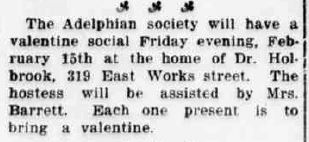
Two women, Sarah Leitner and Frances Josselyn, went all out the evening after, hosting what sounds like quite an elegant and colorful party. Guests were even treated to bluebird place cards with a “dainty message” from St. Valentine himself.


Click here to go to the library's Facebook post.


Thursday, February 8, 2018

You're Never Too Young: Dr. Samuel W. Service, Sheridan's 'Grand Old Man'

We found this colorful character when helping a patron with genealogical research.


A local character of the most colorful variety, Dr. Samuel W. Service lived his remaining years in Sheridan, creating many stories to share.

The world didn't know what it was in for when Service entered it on January 1, 1826, in New York.

He went on to serve in three, count'em three, wars, as a veterinary surgeon: the Civil War, the Indian Wars of the 1870s, and the Spanish-American War.

During his long tenure in the United States military, he won "blue letters of praise and commendations from leaders under which he operated." In 1910, he was commissioned to report to Fort MacKenzie, after spending some time at Fort Ethan Allen in Virginia and Canada. He was 84 and according to Sheridan newspapers, held the record for the oldest actively serving member of the U.S. armed forces.

As though his military career didn't add enough color to his life, Service was also a "graduate optician and expert jeweler." At 77, when most folks start hitting the rocking chair, S.W. Service would have none of it. He moved to Sheridan where he started a jewelry store with his son, William, at 41 S. Main.

From the June 10, 1910 edition of the Sheridan Post.
Click to enlarge.
Ten or so years later, Dr. Service opened a veterinary hospital in the back of that jewelry store, after returning from duty at Fort Ethan Allen. He later moved the hospital to his residence at 835 Olive Street.

Well into his 90s, Service, known then affectionately as 'Sheridan's Grand Old Man,' made it a point to see all he could of the region, travelling by car a couple times a year--a pretty big deal in the 1910s.

When at the home front, he loved "mix[ing] with the boys" at the Eagles' lodge.

In 1924, he made front page news when he went sledding with local kids down the Park Street hill--just weeks after he was hit by a car. All of this when he was 98 years old.

Later that same year, Service suffered a stroke, causing many to fear the worst. It didn't stop him. Not by a long shot.

To top it all off, at age 102, Dr. Service made news again when he almost blew up a hat shop downtown after lighting his pipe too close to the cleaning machine (gasoline was used to clean hats back then). You do have to look your best, no matter your age.

Service passed away in his sleep at home in December 1929 after what we can all agree was a long, full life. At the time of his death, he was one of the few remaining Civil War veterans in the country.

Photo credit: The Sheridan Enterprise.

Click here to go to the library's Facebook post.

Wednesday, January 31, 2018

Brooks Hill Sledding Accident: A Safety Warning from 1925


Sheridan's Brooks Street hill is a steep and tempting one for area youngsters.

On January 18, 1925, a light fog cloaked that Saturday afternoon, a fairly warm one for January with the mercury pushing 40 degrees. As 9-year-old Frank Blum and his chum boarded their sleds at the crest of Brooks Street Hill, they threw caution to the wind. As the boys rocketed through the Burkitt Street intersection, Frank’s buddy slid through, missing Walter Small’s car by a hair. But Blum wasn’t so lucky.


Just a hair behind, he ran smack dab into the car’s rear wheel. Blum was rushed to Sheridan County Memorial where he lay in serious condition for days. The story does have a happy ending…eventually. Young Mr. Blum spent (at least) the next month at home, recuperating with a fractured skull and other injuries. Sadly, he wasn’t the first or the last: the article referenced below begins “Frank Blum…was the first coasting victim of the year.”

Click here to go to the library's Facebook post.